Spectrum
Read more
The Challenge
For Q1 2026, the business set a goal to increase internet bundle sales. The challenge was to redesign the landing page, lead form, and thank-you page to better guide customers toward completing a bundle purchase.
Solution
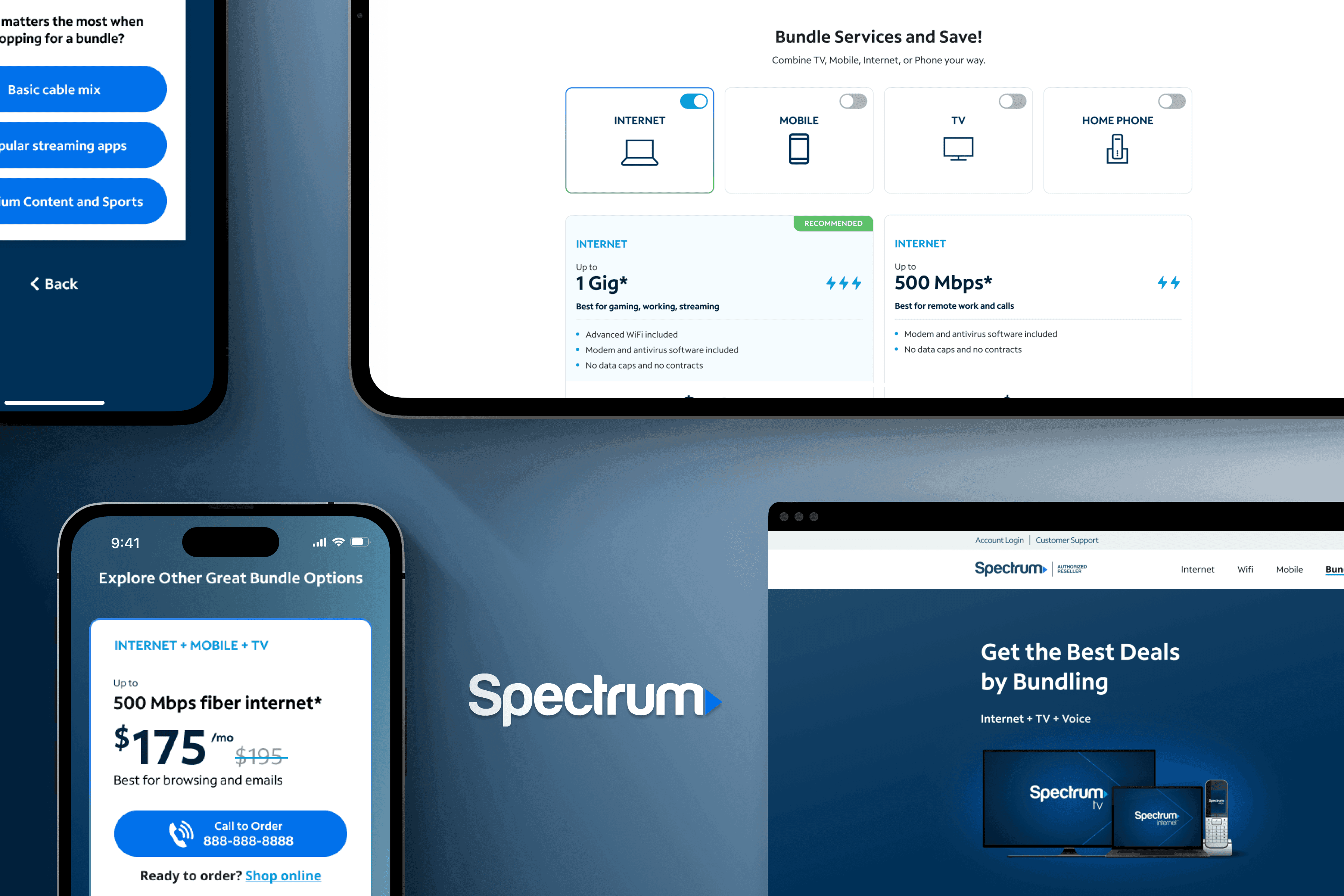
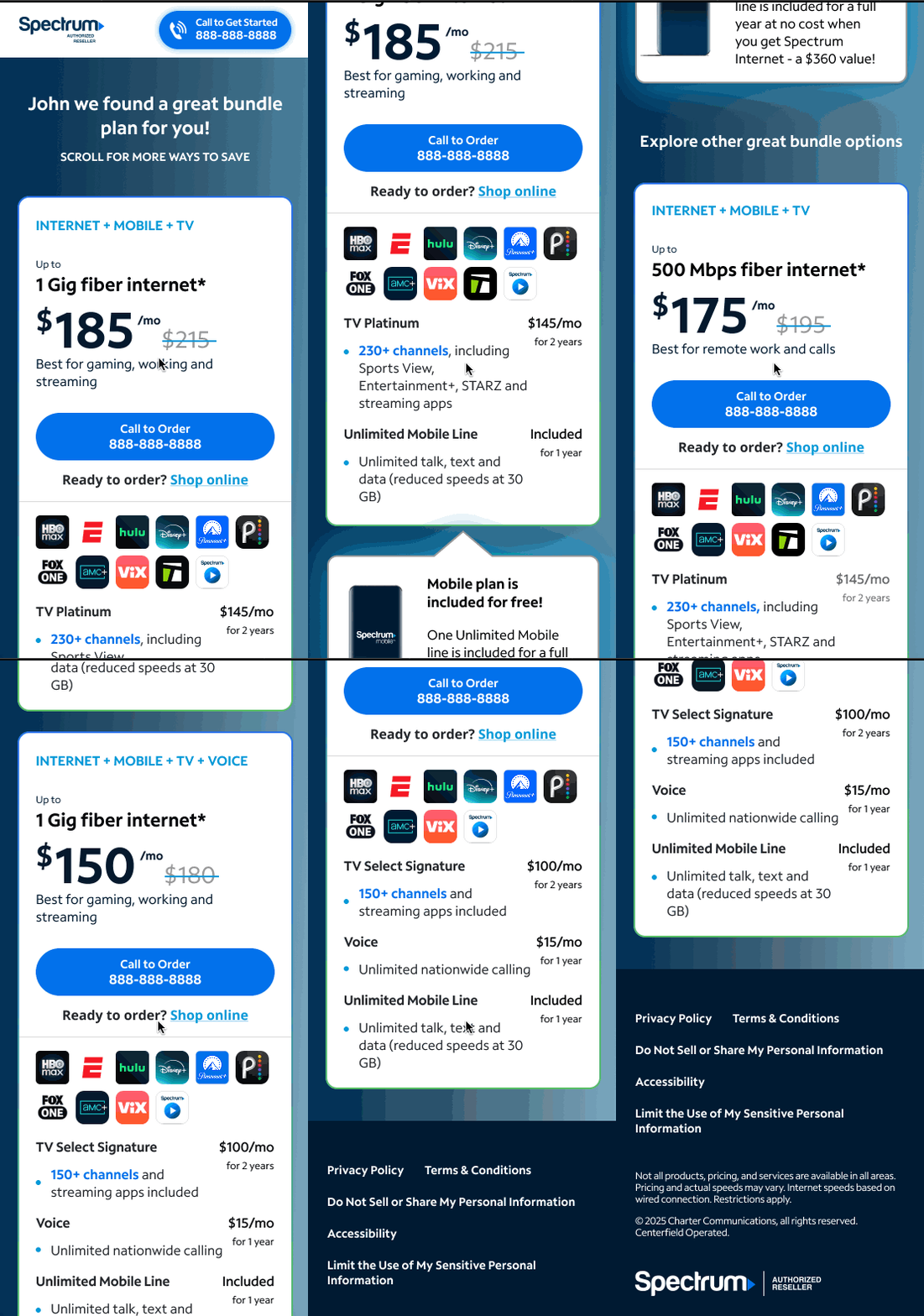
I tackled the drop-off in bundle sales by simplifying the decision-making process. By introducing a guided survey, I was able to serve users a 'Best Match' bundle that aligned with their specific needs. I then reinforced this value on the thank-you page through redesigned plan cards that clearly visualized the cost savings of bundling services compared to standalone internet
Role
Product Designer
Industry
Ecommerce
Timeline
November - January 2026
Team
Solo Designer
Michael (Engineer)
Christy (Ad Ops)
Feon (PM)
Tools
Figma
Claude
Userlytics
While at Centerfield, I served as the Lead Product Designer for our Spectrum account.
Spectrum Bundles Redesign
A prototype showing the user journey from the bundles landing page through the 'Best Match' survey to a personalized plan.
See prototype
02. Design Challenge
How might I redesign the bundles page to better guide customers towards making a bundles purchase?
03. Design process at Centerfield
User centered design process
My design process at Centerfield is a highly collaborative cycle of cross-functional reviews, rapid user testing, and data-driven refinement.
1
Meeting with my PM
I kicked off this project with a meeting with my PM. She and I went over the business objectives and brainstormed potential directions for this project.
2
Claude-to-Figma MCP
My design process has changed a lot with AI. It allows me to rapidly iterate and ensure that my designs are production ready.
3
Getting feedback from other designers
After completing my initial designs, I met with two Senior Designers on my Team for feedback on my work.
4
Client alignment
I met with Spectrum directly to ensure they were kept in the loop.
5
UXR
I designed an unmoderated usability study with 8 participants using the platform Userlytics.
6
Meeting with engineers
Partnered with engineering early to align on technical feasibility, ensuring my recommendation logic was feasible.
7
A/B testing
My design was launched as the challenger in a two-week experiment to validate the new bundling logic.
8
Test results
I analyzed the page event data and core KPIs.
04. Design explorations
Plan card design
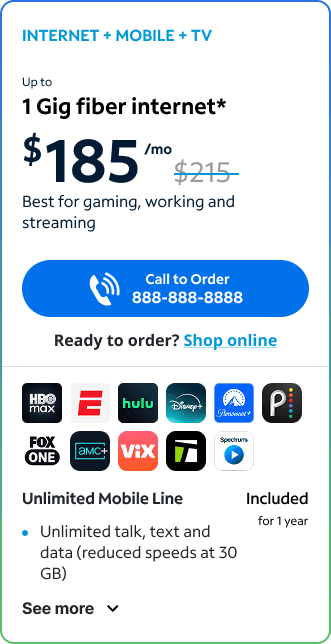
The original plan cards had a very simplistic design with limiting information to tell the user the value of bundling.
TV
STARTING AT
$100
/mo
for Spectrum TV® Signature
INTERNET
STARTING AT
$50
/mo
for Spectrum Internet® Premier
VOICE
STARTING AT
$10
/mo
when added to a bundle including
Internet, TV and/or Mobile
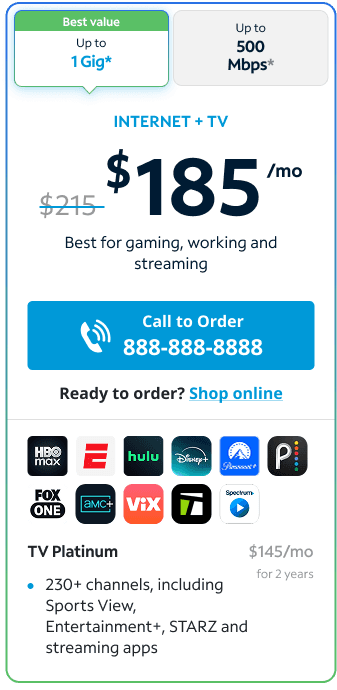
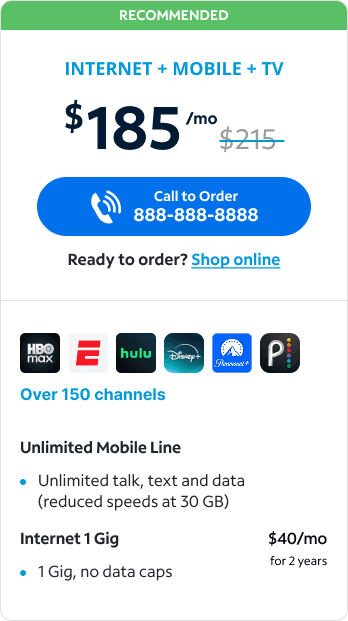
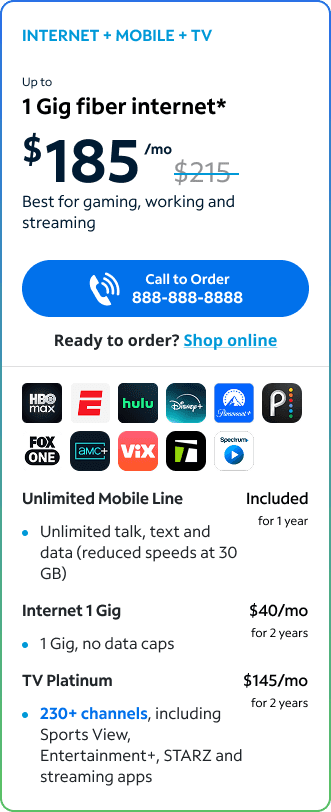
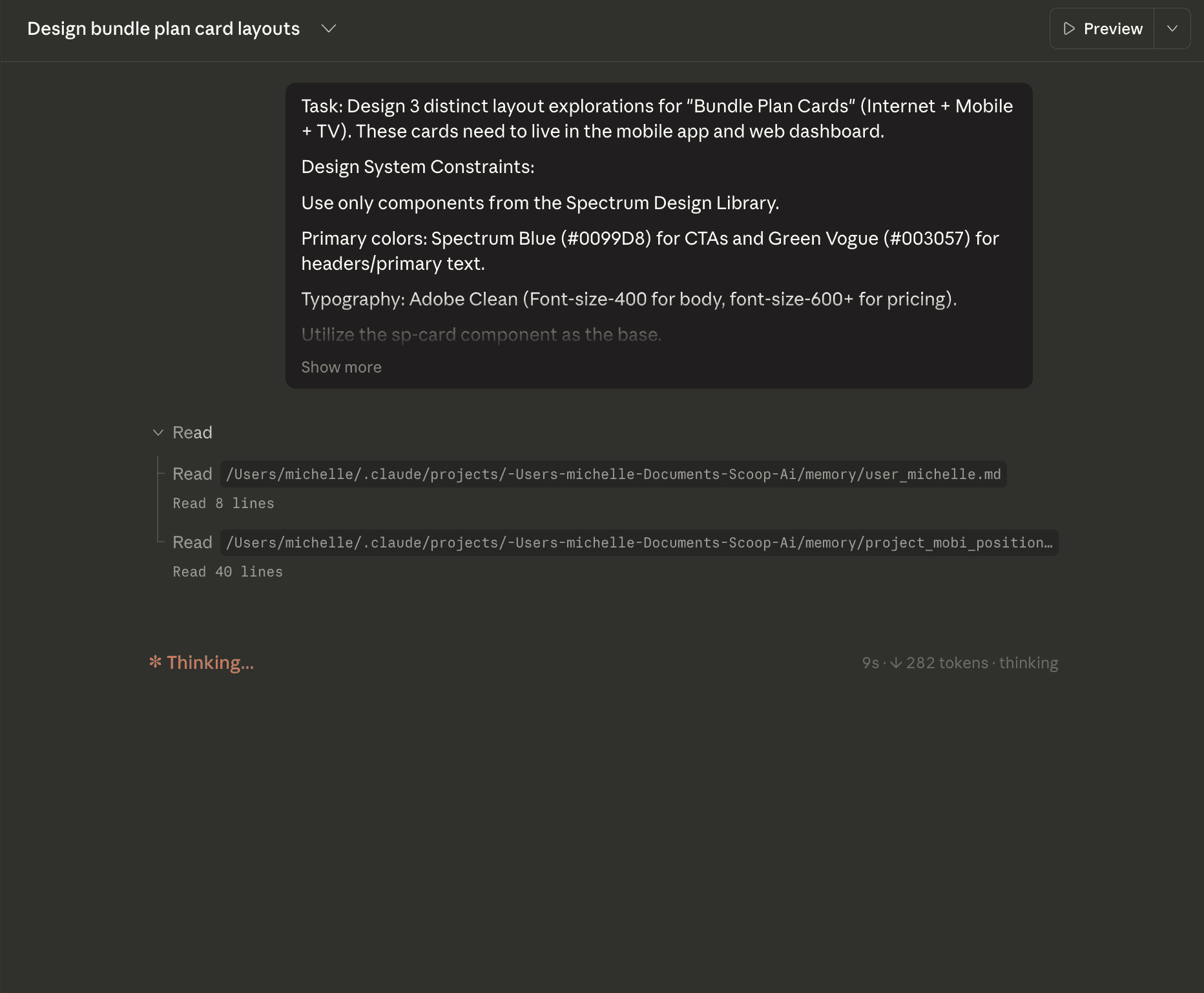
I explored many different options for the redesign. These are just four. I also I streamlined the exploration phase by leveraging the Claude-to-Figma MCP, allowing me to programmatically generate multiple layout variations for the Spectrum bundle cards while adhering strictly to existing design system tokens.
Survey logic
A major technical challenge involved managing Spectrum’s 68 unique service combinations. To avoid the design and engineering debt of creating 68 individual plan cards, I developed a scalable logic system that dynamically handles bundling permutations across Internet, TV, Voice, and Mobile.
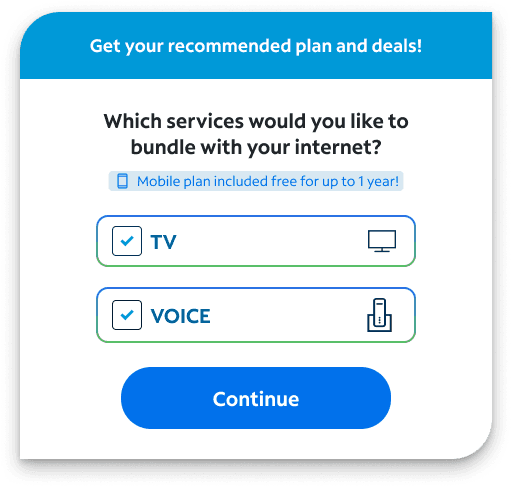
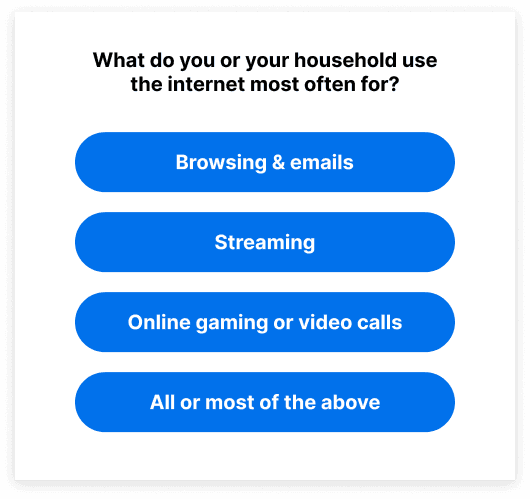
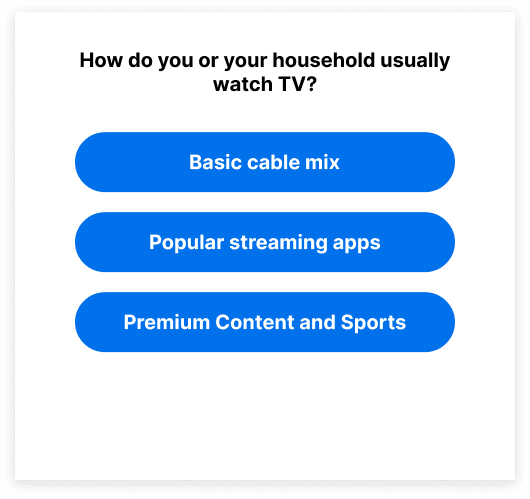
To simplify this complexity, I designed a three-question diagnostic survey that maps user needs to 10 distinct logic paths. This system narrowed 68 possible permutations down to 10 highly relevant, personalized recommendations.
The thank you page design
I met with 2 senior designers at the company to get feedback on the overall design.
05. Usability study
Unmoderated usability study
I conducted a usability study with 8 participants to validate the new logic. Analyzing these sessions revealed several recurring themes.
Key takeaways
7/8
participants noted the new plan cards were 'effortless to scan,' allowing them to compare bundle savings against standalone internet
6/8
participants stated they would be 'Very Likely' to explore Spectrum bundles over a single-service plan
Areas of improvement
“I feel unsure which option to pick because my household does all of them, and I don’t want to choose something that leads to an inaccurate recommendation.”
Mike S
Spectrum user
“The itemized breakdown of what’s included is useful, but the unexplained leftover cost makes the pricing feel confusing and incomplete.”
Kelly L
Spectrum user
06. Test results
A/B testing
This test ran for a total of 2 weeks getting <30,000 visitors to reach statistical significance.
+12.9%
lift in SPV
+5.2%
lift in TE
+11.6%
lift in CR
07. Impact and evolution
Retrospective
This project proved that users prioritize clear information over minimalist design when making complex purchases. Building on past wins, I realized that providing more detailed data was the key to demonstrating true bundling value. By condensing 68 plan permutations into a three-question diagnostic flow, I reduced cognitive load while delivering highly relevant content. The double-digit lift across all core KPIs confirms that transparency and guided logic directly drive higher-tier conversions. This experience solidified my approach to bridging technical backend complexity with an intuitive user experience.
